
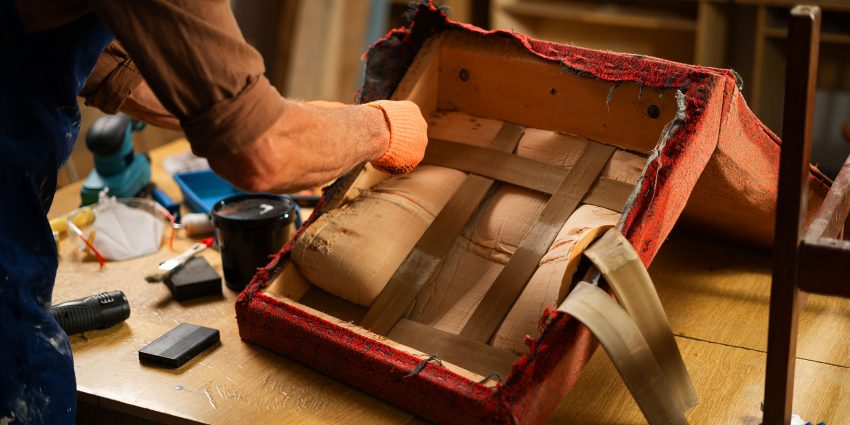
Corners and seams are the two places where upholstery work either confirms or undermines everything else. The center sections can look impeccable. But a corner that bunches, or a seam that wanders, draws the eye immediately and holds it there. Getting these elements right consistently requires more than patience. It requires the right tools used in the right sequence.
The Core Tools Every Upholsterer Needs for Corners and Seams
Before diving into how each tool works, it helps to know which ones actually move the needle on corner and seam quality. These are the instruments that experienced upholsterers rely on when the details need to be exact:
- A regulator needle for adjusting padding and fabric from inside the piece
- Upholstery skewers for holding fabric in position before permanent fastening
- Curved needles in multiple arc profiles for hand stitching on rounded sections
- Upholstery pliers for generating and holding consistent tension at corners
- A tack hammer with a magnetic tip for precise, controlled fastening in tight spaces
- Seam-setting tools or a wooden slicker for pressing welting and piping flat after application
Each one addresses a specific problem. None of them is redundant. Together, they cover the full range of challenges that corners and seams present across different furniture types and fabric weights.
The Regulator: Underused and Underappreciated
Ask experienced upholsterers which tool they reach for most during the finishing phase, and a regulator appears on that list more often than most beginners expect.
A regulator is a long, pointed steel needle used to manipulate padding and fabric from inside a piece after it has been partially or fully assembled. It lets you redistribute filling that has shifted during fabric application, adjust the position of tufting twine without reopening a section, and coax fabric into position at corners and seams without disturbing the surrounding material.
It addresses problems from inside rather than requiring disassembly. For corners where the internal padding has migrated slightly out of position, it solves in seconds what would otherwise take several minutes of rework.
Upholstery Skewers for Temporary Placement
Before staples or tacks go in permanently, position matters. Upholstery skewers hold fabric in place during the tension-checking and alignment phase, allowing adjustments without commitment.
This is especially useful at seams. A seam that gets stapled before the full run has been checked for alignment often drifts subtly from one end to the other, a small deviation at the start becoming a visible offset by the finish. Skewering the entire seam first and standing back to check alignment before any permanent fastening catches these issues when they’re still easy to correct.
Good skewers stay put under moderate fabric tension without bending. Thin, flimsy ones shift or bow, which defeats the purpose entirely.
Curved Needles for Blind Stitching
Certain seams and joins on curved sections, scroll arms, and covered backs require hand stitching rather than stapling. The needle geometry matters enormously here.
A correctly curved upholstery needle follows the surface contour of the piece, allowing the stitch to travel through the material at a consistent depth without breaking the surface on the exterior side. A straight needle on the same task requires awkward wrist angles and produces uneven depth across the stitch run.
Curved needles come in various arc profiles for a reason. Tighter curves suit smaller sections and intricate joins. Shallower curves work better across larger panel seams. Using the right arc for the specific section produces stitching that sits flat, pulls evenly, and holds without visible distortion.
Upholstery Pliers for Consistent Corner Tension
Corners require simultaneous tension across two planes. Hands alone can rarely deliver enough consistent pull while also positioning the fold accurately. Upholstery pliers provide the mechanical grip that holds one tension line stable while the other gets adjusted.
The jaw design matters. Wide, serrated jaws grip fabric without tearing even delicate material when used with appropriate force. They hold position without slipping mid-pull, which is what allows the upholsterer to focus on the fold sequence rather than fighting to maintain tension.
A corner pulled and secured with proper pliers looks decisively different from one done by hand. The fabric sits flatter, the fold stacks more compactly, and the finished point reads cleaner from every angle.
Getting the Details Right
Perfect corners and seams don’t come from being careful in a general sense. They come from using specific tools for specific tasks at each stage of the process. The regulator adjusts what can’t be seen. The skewers hold what hasn’t been decided yet. The curved needle stitches what can’t be stapled. The pliers grip what hands can’t hold consistently.
Together, they form a sequence that turns difficult details into repeatable results.